Semiconductor for Scalable Quantum Information Technologies
NJU International Fellowship Initiative Lecture
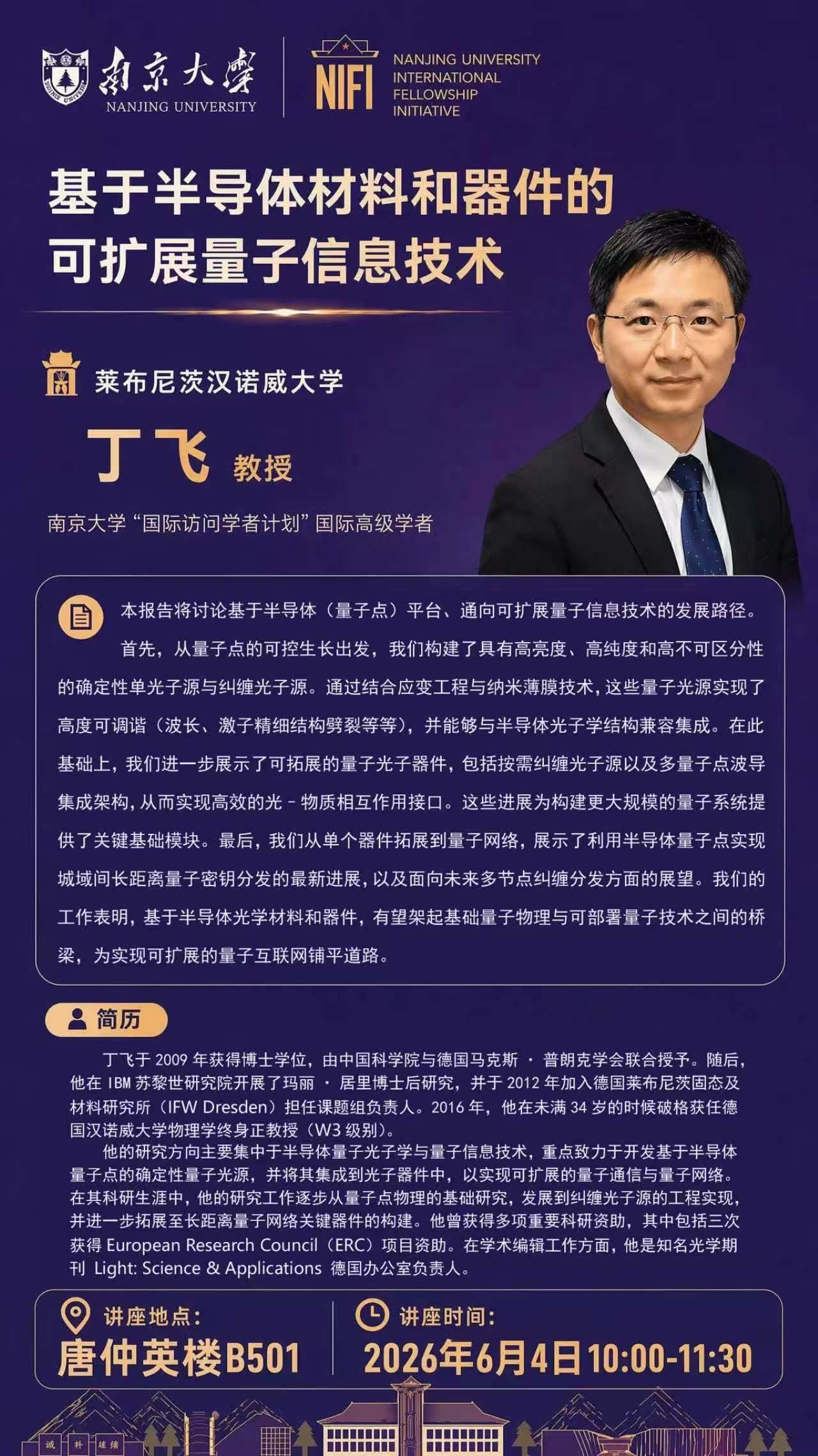
by Fei Ding, Leibniz University Hannover, Germany
Time: 10.00-11.30 a.m., July 4, 2026
Place: B501, Tangzhongying Building, Gulou Campus
Breif Intro of the talk:
This talk presents a coherent pathway toward scalable quantum information technologies based on semiconductor platforms. Starting from the controlled growth of quantum dots, we establish deterministic single-photon and entangled-photon sources with high brightness, purity, and indistinguishability. By integrating strain engineering and nanomembrane techniques, these emitters become highly tunable and compatible with photonic structures.
Building on this, we demonstrate advanced quantum photonic devices, including on-demand entangled photon sources and chip-integrated architectures, enabling efficient light–matter interfaces. These developments provide the essential building blocks for larger-scale systems.
Finally, we extend from single devices to quantum networks, showcasing long-distance quantum key distribution and progress toward multi-node entanglement distribution. This work highlights how semiconductor-based approaches can bridge the gap between fundamental quantum physics and deployable quantum technologies, paving the way toward a scalable quantum internet.
Short Bio:
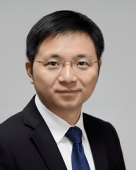
Fei Ding obtained PhD in 2009, from the Chinese Academy of Sciences and Max Planck Society in Germany. After a Marie Curie postdoctoral study at IBM Zurich, he joined IFW Dresden as a group leader in 2012. He has been a full professor of physics at Leibniz University Hannover since 2016. He specializes in semiconductor quantum photonics and quantum information technologies. His research focuses on developing deterministic quantum light sources based on semiconductor quantum dots, as well as their integration into photonic devices for scalable quantum communication and networks. Over the course of his career, he has advanced from fundamental studies of quantum dot physics to engineering entangled photon sources and, more recently, to building components for long-distance quantum networks. He is the recipient of multiple prestigious grants, including three times funding by European Research Council (ERC). Among the editorial works, he is leading the German editorial office of "Light: Science and Applications".


