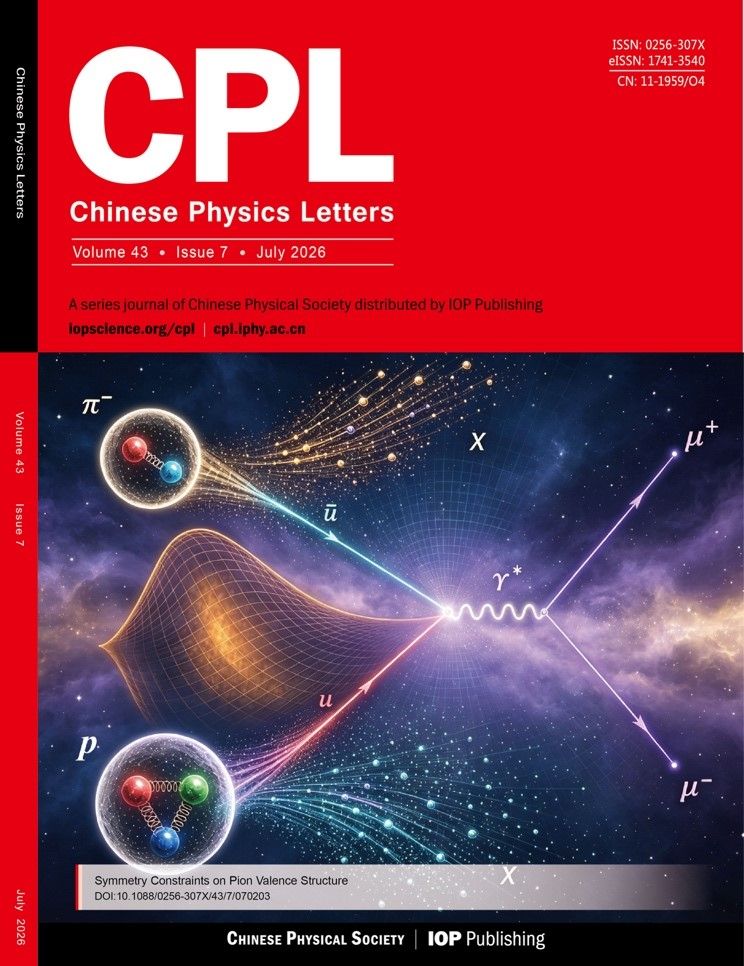
Recently, achieving a major hadroparticle physics breakthrough, Asst. Prof. Minghui Ding and Prof. Craig D Roberts, in collaboration with researchers at Nankai University and the University of Huelva (Spain), delivered a set of unique, model-independent predictions that address an international 35-year controversy generated by a much-cited measurement of pion structure observables – the E615 experiment at FermiLab in the USA. In an extensive international effort, the world's top accelerator facilities, including Jefferson Lab (USA) and CERN (Europe), are collecting/will collect new data aimed at resolving the controversy. The Ding-Roberts team's new analysis is entirely algebraic, and its objective predictions cannot be contested by model-dependent, phenomenological analyses of available data, or numerical simulations with unquantified systematic uncertainties. The predictions provide deep-ploughing insights into the structure of Nature's most fundamental pseudo-Goldstone boson. The work was featured as the cover story for the July 2026 issue of Chinese Physics Letters (CPL), which is one of the world's Top-2 multidisciplinary letters journals in physics, and was also highlighted in CPL's international WeChat feed
https://mp.weixin.qq.com/s/9J98SPwIGhjGI8pqajRv3A
Research Background: Quest to Understand the Origin of Mass
In what is today known as the standard model of particle physics (SM), strong interactions are described by quantum chromodynamics (QCD). In the SM, the one phenomenologically understood source of mass for elementary particles is the Higgs boson (Nobel Prize in 2013). Higgs boson couplings into QCD give quark partons their Lagrangian (current) masses. If those couplings are eliminated, then one implements the “chiral limit” and QCD is a mass/length-scale invariant theory. Classically, scale invariant theories cannot support any bound states: the fundamental entities necessary for the construction and stabilization of atomic nuclei (protons, neutrons, pions, etc.) cannot exist. Restoring Higgs boson couplings does not make a huge difference for the quarks/antiquarks that make up the pion and proton. Luckily for nuclear stability, the pion remains light, while the proton becomes very massive. This being the case, the following question immediately begs for an answer: How does a nearly scale invariant theory – characterized by electron-size masses – produce a light pion with a τ-lepton-like mass and, simultaneously, a proton with a nuclear-size mass? In addressing this puzzle, one steps immediately into the realm of emergent strong interaction phenomena (ESIP) and, particularly, the enigma of emergent hadron mass (EHM).
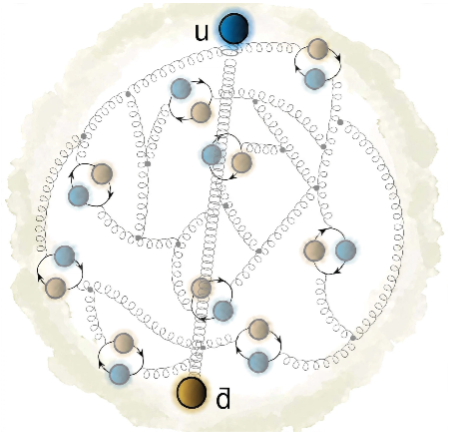
In the quantum field theory that describes strong interactions in the Standard Model of Particle Physics, the positively charged pion, π+ –see figure – contains one valence up (u) quark, one valence anti-down (d ̅) quark, and infinitely many gluons and sea quarks. The distribution of these "partons" throughout the pion's spacetime volume has been a controversial issue for more than 35 years.
Research Details: Nature Knows the Answers
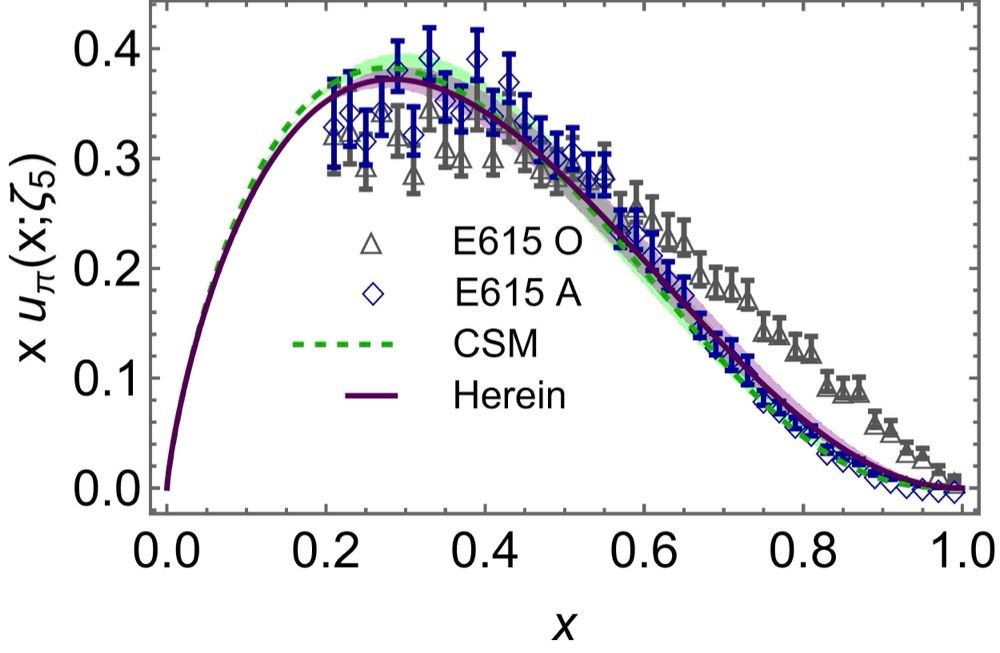
This analysis by the Ding-Roberts team, centered at the Nanjing University Institute for Nonperturbative Physics, capitalizes on the rigorous theory of QCD effective charges. It then exploits two empirical facts of Nature. (i) G-parity is a good symmetry. G-parity is associated with a particular operation in hadroparticle physics, with special relevance to pions. It means that, from a mathematical perspective, all three pion states (π⁺, π⁰, π⁻) are equivalent. (ii) In the scattering of charged leptons from a charged pion target, a monopole representation of the pion structure/form factor is a good approximation. From this Nature-grounded foundation, proceeding entirely algebraically – something practically unheard of in realistic hadroparticle physics theory, the analysis delivered parameter-free predictions for the pion distribution amplitude and valence-quark distribution function, i.e., key characteristics of the pion wave function in quantum field theory. With a few extra steps, the analysis arrived at the prediction for the pion valence-quark number density distribution that is displayed in the figure below. Also displayed in the figure are the prediction made using continuum Schwinger function methods (CSMs) – a modern (numerical) tool for solving QCD – and two different analyses of the controversial E615 data. The Ding-Roberts team's model-independent, Nature-driven prediction confirms the CSM result and indicates that the E615A data analysis very probably employs the correct approach: it therefore provides a strong pointer to resolution of the 35-year controversy.
Summary and Outlook: Quark and Glue Content of Nature's Most Fundamental Nambu-Goldstone Boson
Unveiling the structure of Nature's most fundamental Nambu-Goldstone boson – the pion – is a high-priority goal of modern hadroparticle physics. Using the theory of effective charges in QCD and the fact that the Q2-dependence of the charged-pion elastic electromagnetic form factor is well approximated by a monopole, the Ding-Roberts team delivered a model-independent, parameter-free prediction for the pion’s valence-quark momentum-fraction number-density distribution. Crucially, its behavior on the valence domain of light-front momentum fraction, x ≳ 0.2, is practically indistinguishable from that of an array of predictions derived from QCD. The team's results confirm those obtained using modern continuum Schwinger function methods in QCD and point toward the correct way of analyzing existing and forthcoming data. The study will therefore serve as additional motivation for future theoretical and phenomenological analyses and experiments that aim to resolve existing pion structure function controversies. The team's analysis makes significant steps toward solving a critical, topical problem; and the general character of the approach makes it potentially useful in other and related applications.
Paper Information
Nanjing University is the lead corresponding institution for the work. Asst. Prof. Ding (NJU) is a co-corresponding author of the paper; Prof. Roberts (NJU) is the lead corresponding author; and Prof. Lei Chang (Nankai University) is a co-corresponding author. The work was a truly collaborative effort, with each author contributing original results and thoughts. The research was funded by the National Natural Science Foundation of China, grant no. 12135007, of which Prof. Roberts is the Principal Investigator. The published article, entitled "Symmetry Constraints on Pion Valence Structure" is available at this link:
https://cpl.iphy.ac.cn/article/doi/10.1088/0256-307X/43/7/070203


