In the fractional quantum Hall effect, electrons can fractionalize into quasiparticles. These are referred to as partons, and this picture provides an intuitive framework for understanding fractionalized states. Low-energy partons are equivalent to the established composite fermion states. High-energy partons are predicted to exist, but have not yet been demonstrated experimentally. Recently, a geometrical theory for the fractional quantum Hall effect was proposed. In this description, chiral spin-2 neutral excitations—also termed gravitons—arise from fluctuations of the quantum metric. Here we report the observation of multiple chiral gravitons using circularly polarized resonant inelastic light scattering. At a filling factor of 2/7, our experiments reveal two sharp modes with opposite chiralities that we identify as low- and high-energy gravitons. By contrast, at a filling factor of 2/9, multiple gravitons exhibit the same chirality. In the gapless Fermi-liquid-like state at a filling factor of 1/4, the high-energy graviton persists as a gapped chiral excitation. These observations identify chiral gravitons as geometrical excitations of their corresponding partons. Our work introduces a method to detect partons through chiral graviton measurements, opening the exploration of fractionalized matter.
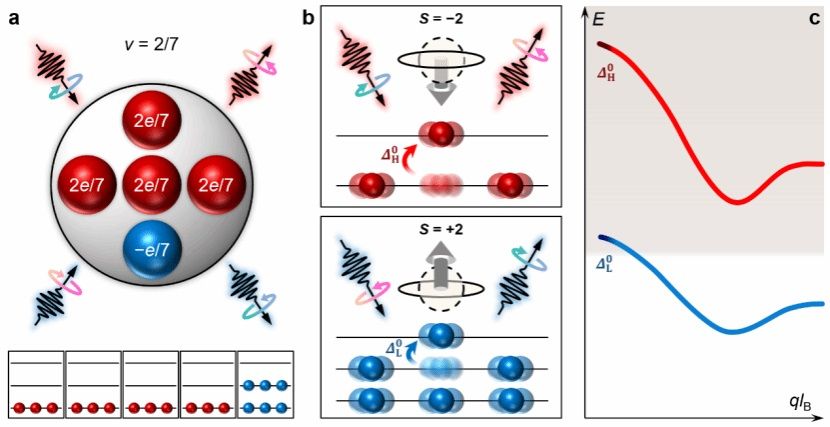
Fig. 1: Partons in FQH systems.
Source: https://www.nature.com/articles/s41567-026-03338-9


