Recently, Professor Xie Ji-Wei and Professor Zhou Ji-Lin's team from the School of Astronomy and Space Science at Nanjing University has made new breakthroughs in understanding the evolutionary divergence of sub-Neptune-sized exoplanets. Using observational data from China's LAMOST, ESA's Gaia satellite, and NASA's Kepler space telescope, the team systematically uncovered for the first time that "super-Earths" and "mini-Neptunes" follow different orbital eccentricity–period relations. This discovery shows that the two populations have dramatically different fates: super-Earths have experienced violent gravitational scattering and giant impacts, while mini-Neptunes have long resided in dynamically quiet, long-term perturbation evolution. The relevant research results were published online on June 12, 2026, in the journal Science under the title "Super-Earths and mini-Neptunes follow different orbital period–eccentricity relations".
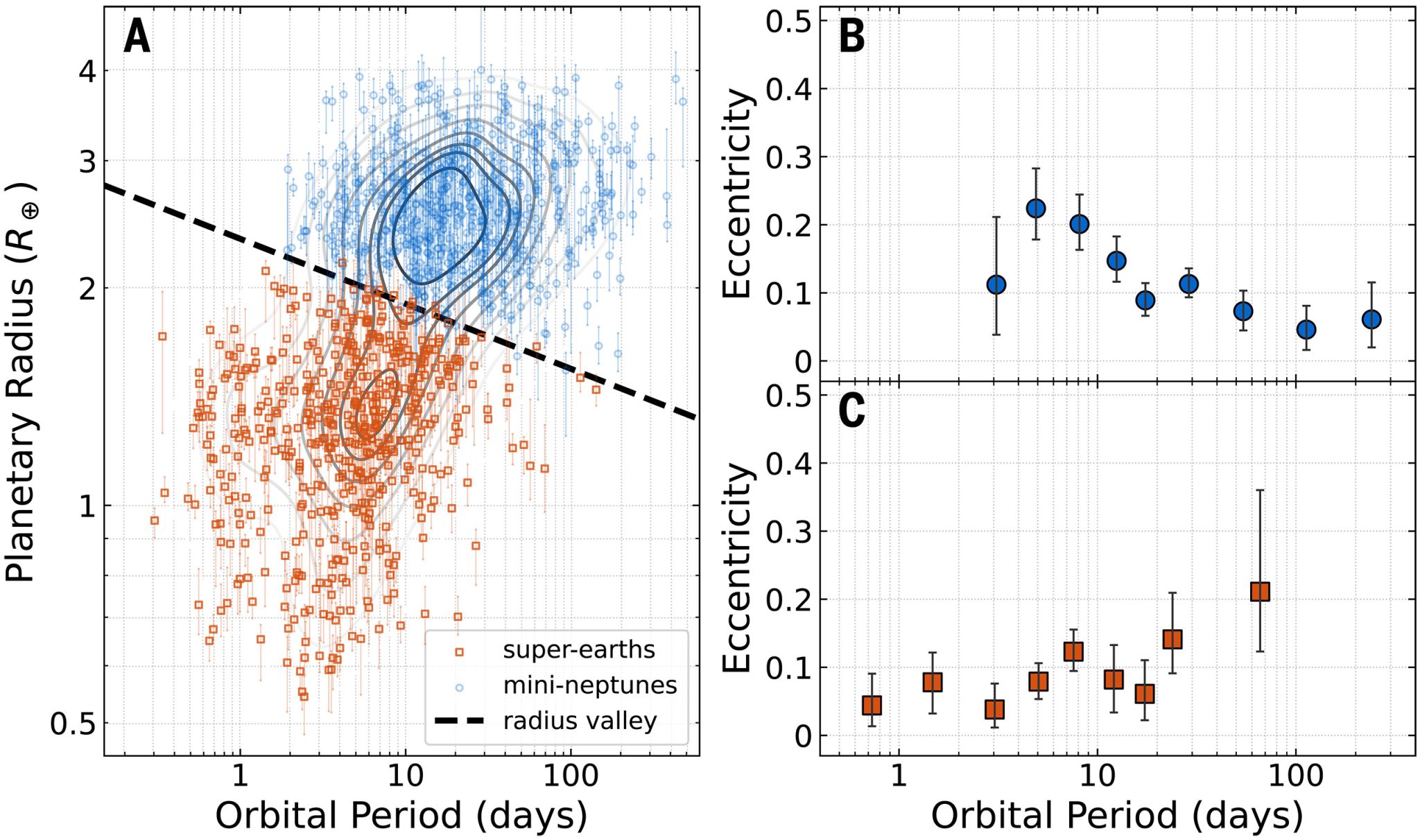
Fig. Radii and eccentricities of the fiducial Kepler sample.
(A) Planet radius (in earth radii, ) as a function of orbital period for SEs (orange squares) and MNs (blue circles) in the fiducial sample of Kepler transits. The gray contours show the number density, which was smoothed using Gaussian kernel density estimation. The black dashed line indicates the empirical position of the radius valley (see equation S8) for an illustrative host star of one solar mass. Classification of each exoplanet used the actual observed mass of its host star (19). (B) Mean orbital periods and eccentricities of MNs derived using the TDR method for each orbital period bin. (C) Same as panel (B) but for SEs. All error bars indicate 1σ uncertainties.
Source: https://www.science.org/doi/10.1126/science.adu3916


