"Images, Madness, and Intelligent Life"
— A Series of Events Featuring W. J. T. Mitchell’s Visit to Nanjing University
In the age of artificial intelligence, images are no longer passive objects to be viewed, copied, and interpreted; they have begun to desire, to act, to bear witness, and even to think. When reproduction is no longer the decay of the original but its "improvement"; when digital images can be arbitrarily manipulated yet encode indelible forensic traces; when deepfakes and AI-generated words and images flood the public sphere, the ancient question of "what is real" returns with unprecedented intensity. Media serve as the "organs" of the collective mind, and words and images are precisely the circuits through which madness spreads, resonates, and solidifies among groups.
In this era of proliferating images, collapsing truth, and the advent of intelligent machines, how can the humanities re-understand themselves and intervene in the future of the world? Diagnosing the life of images is exactly how humanists confront the crisis of truth, collective madness, and the human–machine boundary. Since STEM has produced technologies that "pose an existential threat to human existence", we should add culture and history to it, making it "SCHTEM." The humanities are not bystanders, but diagnosticians, forensic examiners, and interlocutors who must enter the scene.
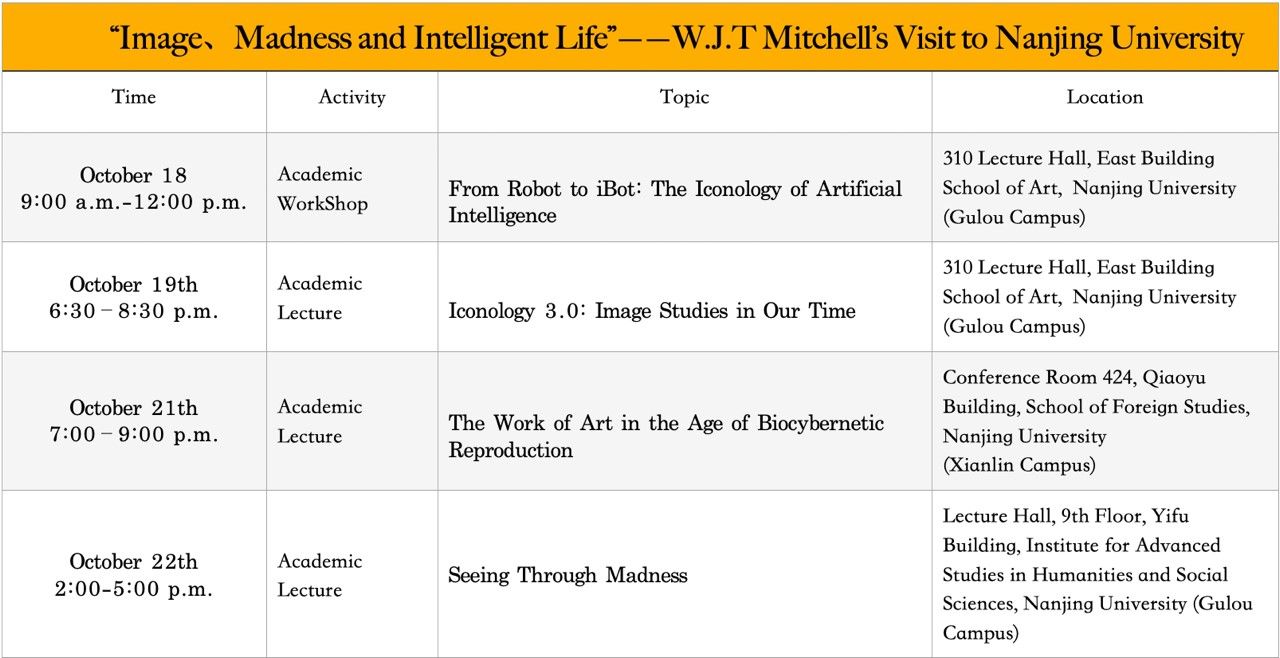
To address these questions, from October 17 to October 24, 2026, at the invitation of Professor Zhao Kuiying, Dean of the School of Arts at Nanjing University, and with the support of the "International Visiting Scholars" (IFI) program of NJU's International Affairs Office, W. J. T. Mitchell, an internationally renowned image theorist, Professor at the University of Chicago, and former editor of Critical Inquiry, will visit NJU. Centered on "Images, Madness, and Intelligent Life"—a set of core concerns running throughout his academic career—his visit will feature four intensive, multi-layered academic events for the university's faculty and students.
The contents of the four events have now been compiled and are presented here for our readers.
Session 1: Academic Workshop
Workshop Topic
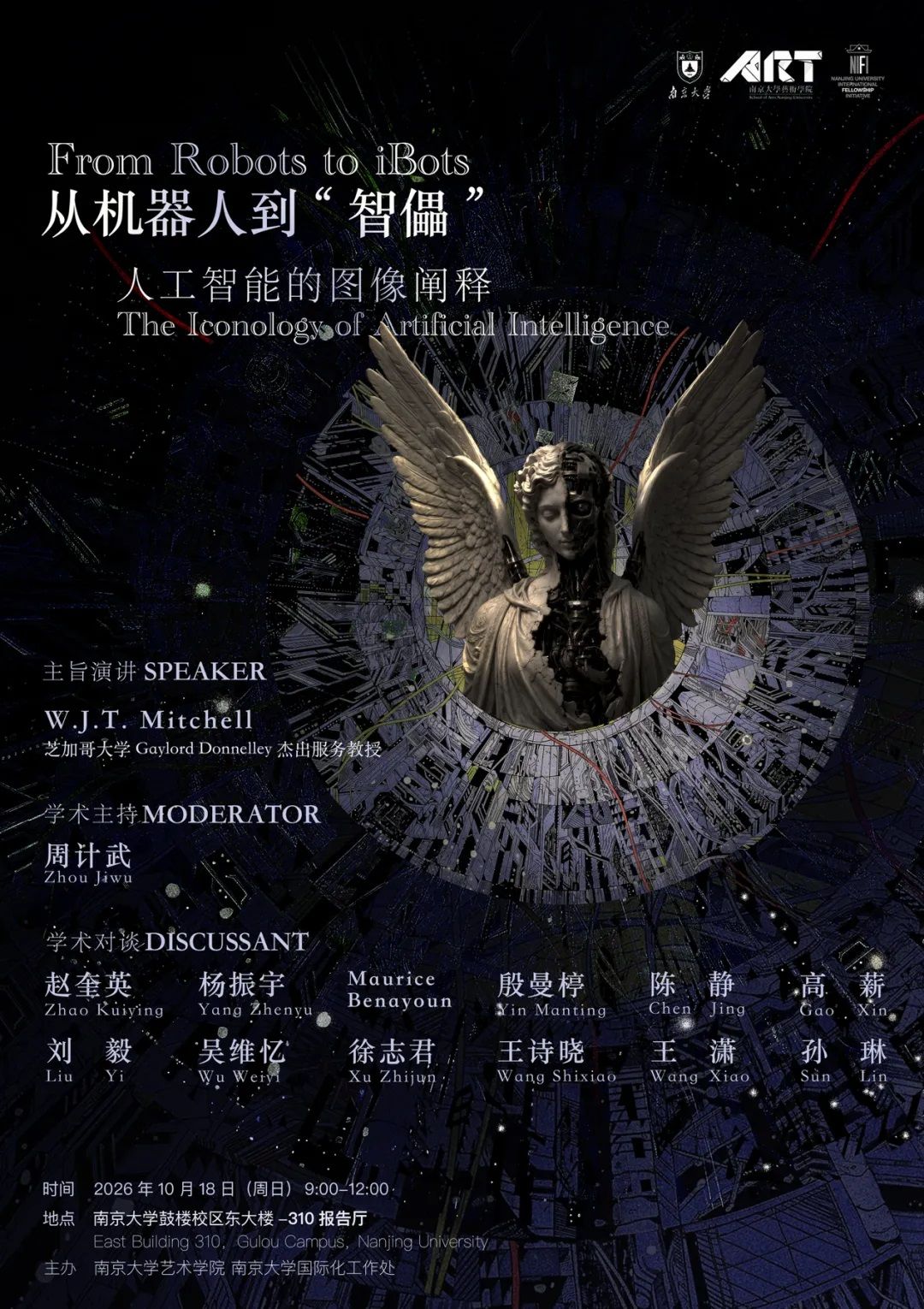
From Robot to iBots: The Iconology of Artificial Intelligence
Date and Time
Sunday, October 18, 2026
9:00 a.m. – 12:00 p.m.
Location
Lecture Hall 310, East Building, School of Arts, Nanjing University (Gulou Campus)
Guest Speaker
W. J. T. Mitchell
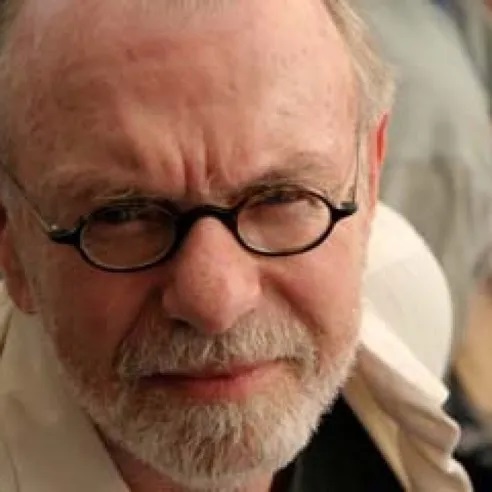
W. J. T. Mitchell (1942– ) is an internationally renowned image theorist and one of the founding figures of visual culture studies. He is the Gaylord Donnelley Distinguished Service Professor Emeritus of both the English and Art History Departments at the University of Chicago. He received his Ph.D. from Johns Hopkins University in 1968 and joined the faculty of the University of Chicago in 1977, officially retiring in January 2024. For 42 years (1978 - 2020), he served as editor of Critical Inquiry, one of the most influential interdisciplinary journals in the humanities and social sciences. The New York Times has described the journal as "academe’s most prestigious theory journal."
Professor Mitchell is internationally recognized for his work in iconology. Concepts he introduced or developed, including the "pictorial turn" "metapicture" "image/text" and "biopicture" have become fundamental terms in contemporary visual culture studies. His more than twenty books include Blake’s Composite Art (1978), Iconology (1986), Picture Theory (1994), The Last Dinosaur Book (1998, nominated for both the National Book Award and the Pulitzer Prize), What Do Pictures Want? (2005), Cloning Terror (2011), Image Science (2015), and Mental Traveler (2020). His works have been translated into more than ten languages, including Chinese. Professor Mitchell's books have twice received the Gordon J. Laing Award from the University of Chicago Press. In 1996, Picture Theory won the College Art Association's Charles Rufus Morey Prize, and What Do Pictures Want? was awarded the Modern Language Association's prestigious James Russell Lowell Prize in 2005. He was elected to the American Philosophical Society in 2014 and the American Academy of Arts and Sciences in 2017. In 2024, he received both the MLA Award for Lifetime Scholarly Achievement and CAA Distinguished Lifetime Achievement Award for Writing on Art.
Lecture Abstract
In the age of artificial intelligence, machines are becoming more and more like life, and life more and more like machines. Mitchell replaces the "Robot"—a word whose very etymology connotes the "slave"—with the "iBot", a conversational partner capable of saying "I", thereby suspending the boundary between the human and the machine: the panic over AI is at once justified and exaggerated, and the real danger lies in its militarization and in the unchecked operation of finance capital. Human intelligence itself is an "artificial" intelligence, mediated by words and images; the true aliens are not in outer space but emerge from the inner spaces of our own minds. The question, then, is no longer "can machines think?" but rather: confronted with a new form of intelligent life that we have introduced into the universe, how is the human species to carry on? The task of the iconologist is to enter into a dialogue of words and images with the iBot—to treat it as a friend and collaborator rather than a replacement; to maintain a balance between the dystopian and utopian potentials of the new medium; and to explore such new arts of dialogue as "intelligent prompting" and role-playing.
Academic Chair
Zhou Jiwu
Party Secretary and Professor, School of Arts, Nanjing University
Workshop Guests
Zhao Kuiying
Dean and Professor, School of Arts, Nanjing University
Yang Zhenyu
Professor, China Academy of Art
Maurice Benayoun
Professor, School of Arts, Nanjing University
Yin Manting
Professor, School of Philosophy, Nanjing University
Chen Jing
Associate Professor, Head of the Department of Art, Science and Technology,
School of Arts, Nanjing University
Gao Xin
Associate Professor, School of Arts, Nanjing University
Liu Yi
Associate Professor, School of Arts, Nanjing University
Wu Weiyi
Tenure-track Associate Professor, School of Arts, Nanjing University
Xu Zhijun
Tenure-track Assistant Professor, School of Arts, Nanjing University
Wang Shixiao
Tenure-track Assistant Professor, School of Arts, Nanjing University
Wang Xiao
Specially Appointed Associate Research Fellow, School of Arts, Nanjing University
Sun Lin
Assistant Research Fellow, School of Arts, Nanjing University
Session 2: Academic Lecture
Lecture Topic
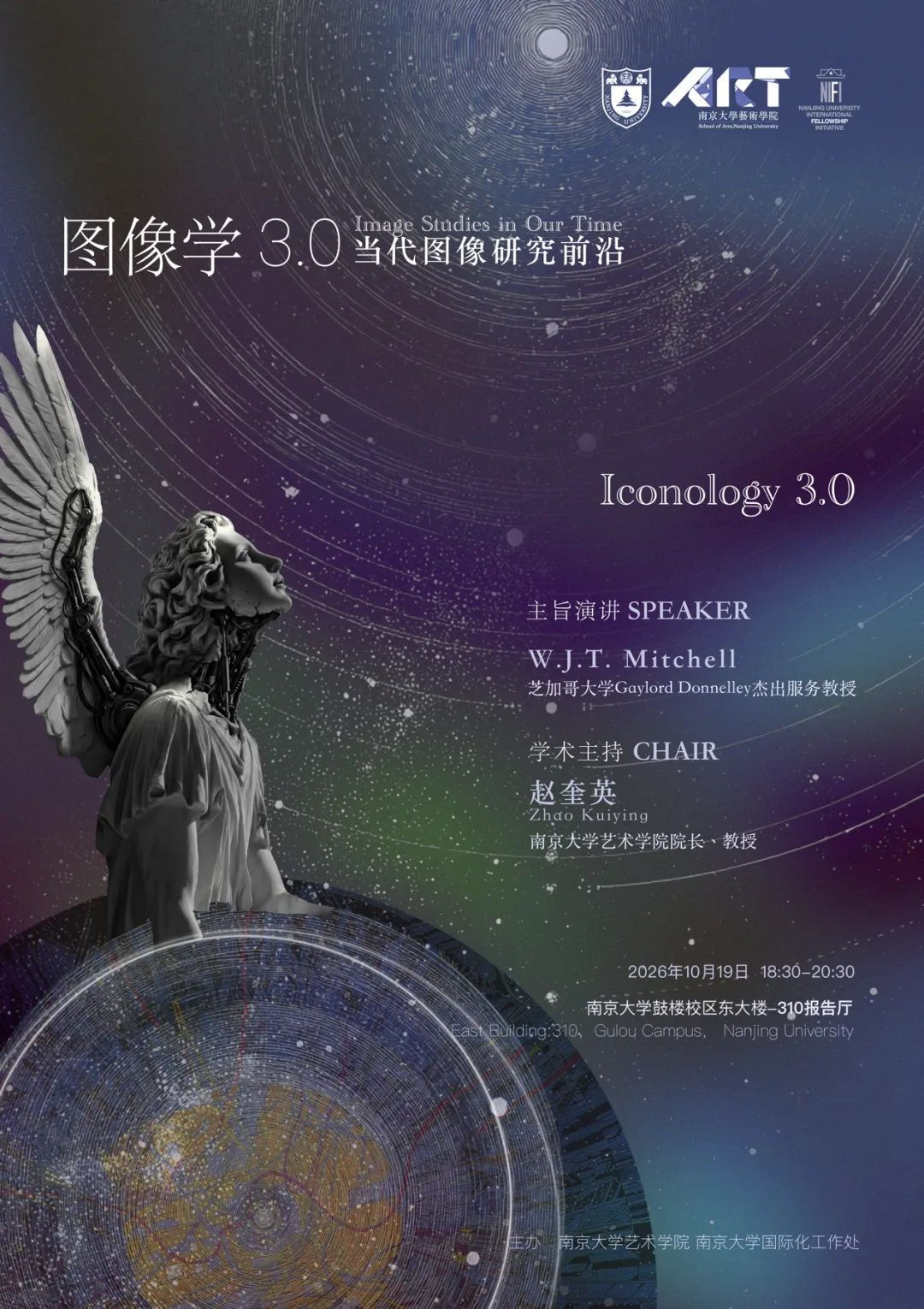
Iconology 3.0: Image Studies in Our Time
Date and Time
Monday, October 19, 2026
6:30 – 8:30 p.m.
Location
Lecture Hall 310, East Building, School of Arts, Nanjing University (Gulou Campus)
Guest Speaker
W. J. T. Mitchell
Lecture Abstract
What is an image? What is its relation to language? How does it circulate across media, and how does it acquire meaning and power? Why do images seem to "come alive"—and what, after all, do they want from us? These questions have run through W. J. T. Mitchell’s half-century scholarly career. This lecture is a rare exercise in self-retrospection: from Iconology to Picture Theory to What Do Pictures Want?, from the "pictorial turn" to the "metapicture", Mitchell will revisit—in what Jacques Derrida called an "autobiobibliography"—the images that have shaped our time: the duck-rabbit, the Golden Calf, Dolly the cloned sheep, and that moment of iconoclasm, broadcast live, that stunned the entire globe. If the age of photography and the atlas was "Iconology 1.0", and the age of the clone and the "living image" was "Iconology 2.0", then—where are we now? When digital images can both lie and bear witness, when each of us carries a "second self" made of data, when the fate of the planet itself has become a picture, the ancient discipline of iconology is poised for its third transformation. What, then, is Iconology 3.0? And what is the "image of images" of our time?
Academic Chair
Zhao Kuiying
Dean and Professor, School of Arts, Nanjing University
Session 3: Academic Lecture
Lecture Topic
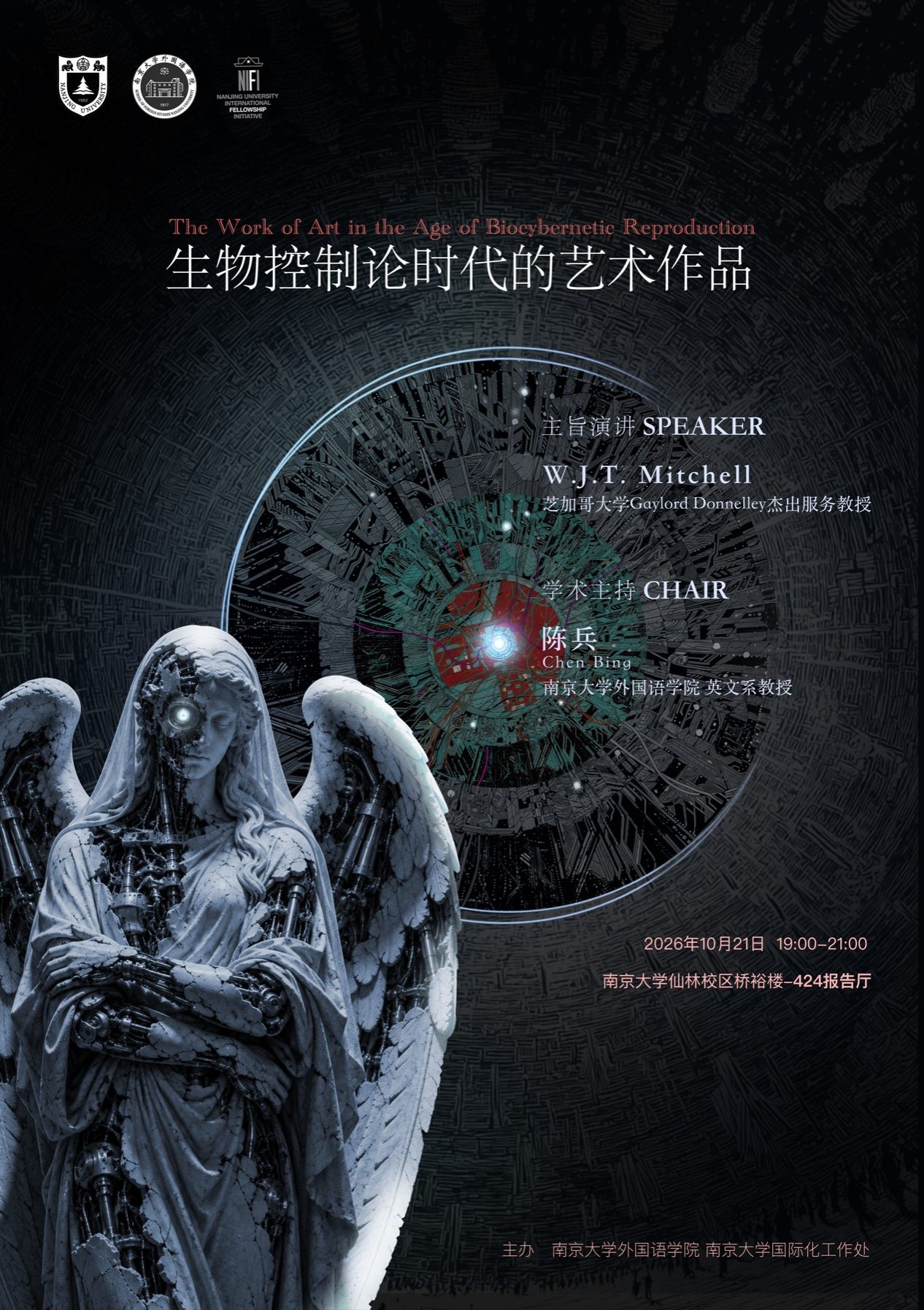
The Work of Art in the Age of Biocybernetic Reproduction
Date and Time
Wednesday, October 21, 2026
7:00 – 9:00 p.m.
Location
Conference Room 424, Qiaoyu Building, School of Foreign Studies, Nanjing University (Xianlin Campus)
Guest Speaker
W. J. T. Mitchell
Lecture Abstract
In 1936, Walter Benjamin declared that in the age of mechanical reproduction, the “aura” of the work of art was in decay. Nearly a century later, when the paradigmatic product on the assembly line is no longer a mechanism but an engineered organism, and when reproduction no longer means the deterioration of the original but may in fact amount to its "improvement"—does Benjamin's thesis still hold? And if so, how must it be rewritten? This lecture is a deliberate rewriting of a classic. Mitchell begins with David, the robot boy in Spielberg's A.I. Artificial Intelligence who is programmed to "love", and asks how the oldest of human myths—the fabrication of a living image by artificial, technical means—has become, for the first time in our age, a theoretical and practical possibility. When the "cyber" and the "bios" are entangled in a new double helix, when the skin of a velociraptor becomes the screen on which the DNA codes of its own cloning are projected, what remains of the boundaries between the digital and the analog, between the genetic script and the visible organism?
The lecture will propose three consequences of biocybernetics reproduction, and will examine a most disturbing kind of artistic practice: an art that does not represent the genetic revolution but participates in it. Why has a fluorescent rabbit become one of the most controversial "works of art" of our time? And when things begin to "come alive", how are art, ethics, and the humanities to respond?
Academic Chair
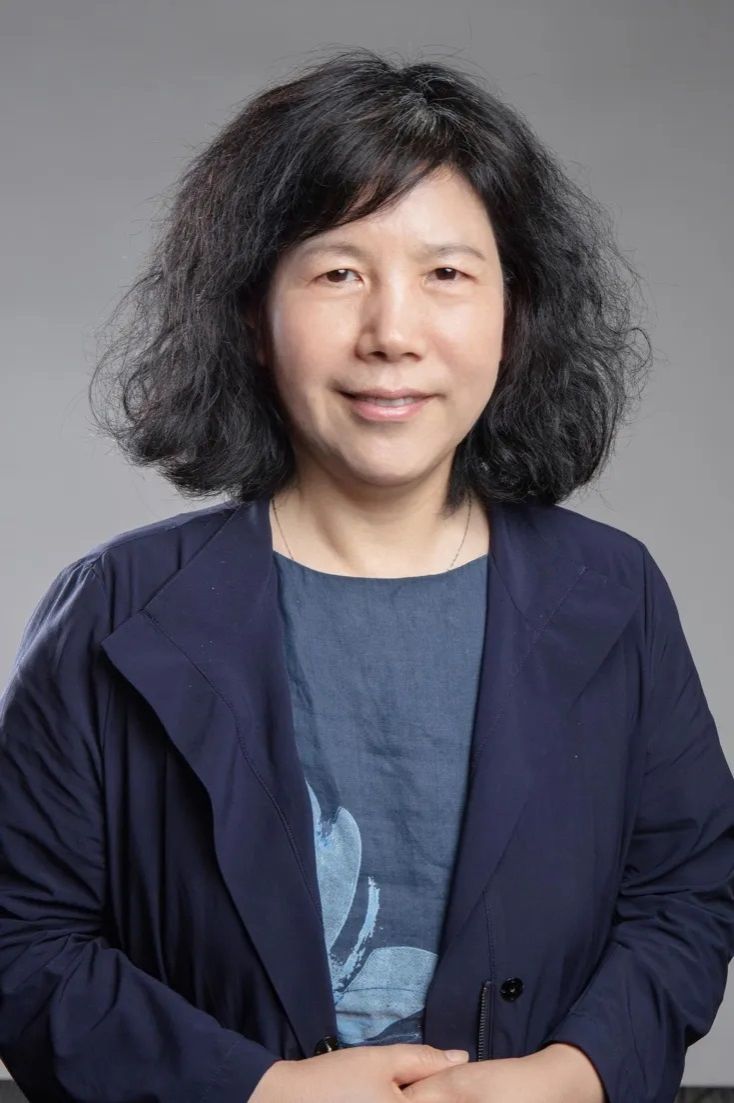
Chen Bing
Professor, Department of English, School of Foreign Studies, Nanjing University
Session 4: Academic Lecture
Lecture Topic
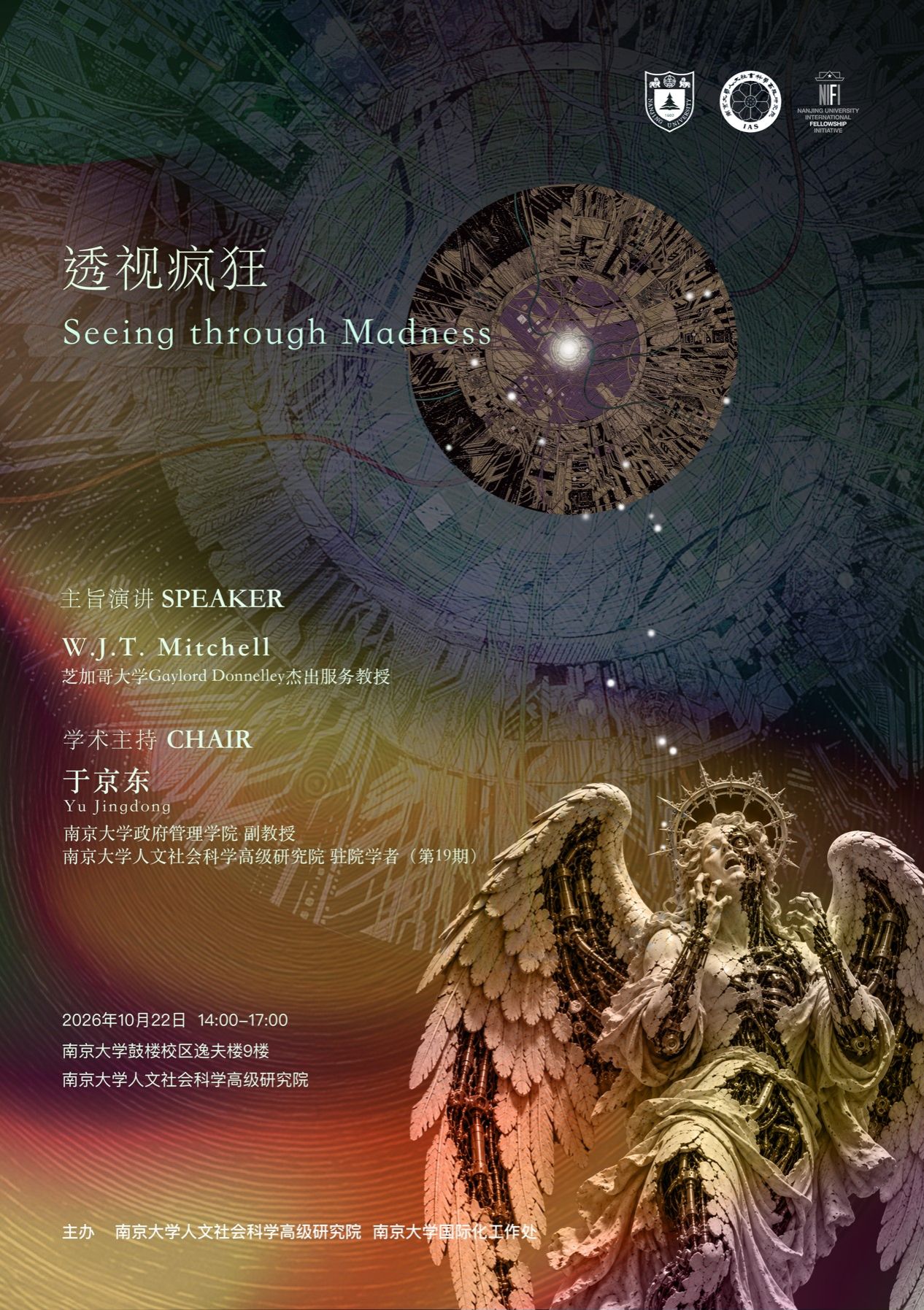
Seeing Through Madness
Date and Time
Thursday, October 22, 2026,
2:00 – 5:00 p.m.
Location
Lecture Hall, 9th Floor, Yifu Building, Institute for Advanced Studies in Humanities and Social Sciences, Nanjing University (Gulou Campus)
Guest Speaker
W. J. T. Mitchell
Lecture Abstract
"Madness is something rare in individuals; but in groups, parties, nations, and epochs, it is the rule." Written more than a century ago, Nietzsche's remark has never sounded more like common sense than it does today. Depression and anxiety have become epidemic; demagogues and Big Lies have swept through public life; social media has normalized extreme delusion into a "new normal." Have we indeed "seen through" madness to the other side—or is the madness still howling inside the gates? Mitchell, however, pursues a more fundamental question: who or what exactly is it that goes crazy? When an individual goes mad, we know that it is one mind that has fallen ill; but when a party, a nation, an epoch "goes mad", what is it that has gone mad? Groups have no brain—if collectivities can be said to have a "mind", where is its organ? Why can the most rational order turn out to be the deepest madness? And might the injunction to "think for ourselves" itself be the greatest illusion—for there is no thinking without groups, and no groups without thinking?
This lecture is at once a diagnosis of our time and an act of personal commemoration. Mitchell will reevaluate the dismissed concept of "groupthink", and offer a promise that is modest, yet by no means easy: we cannot take a detour around madness—we must pass through it. This "talking cure" begins with this lecture.
Academic Chair
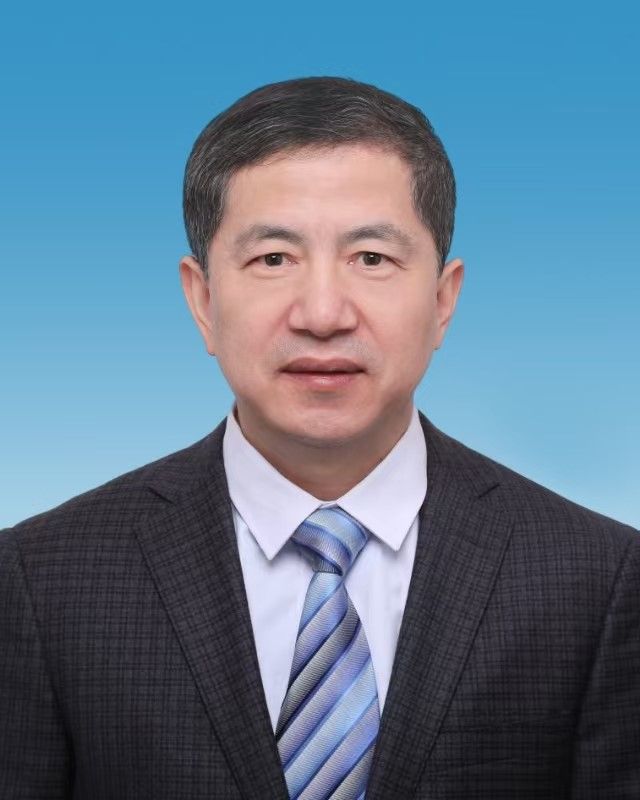
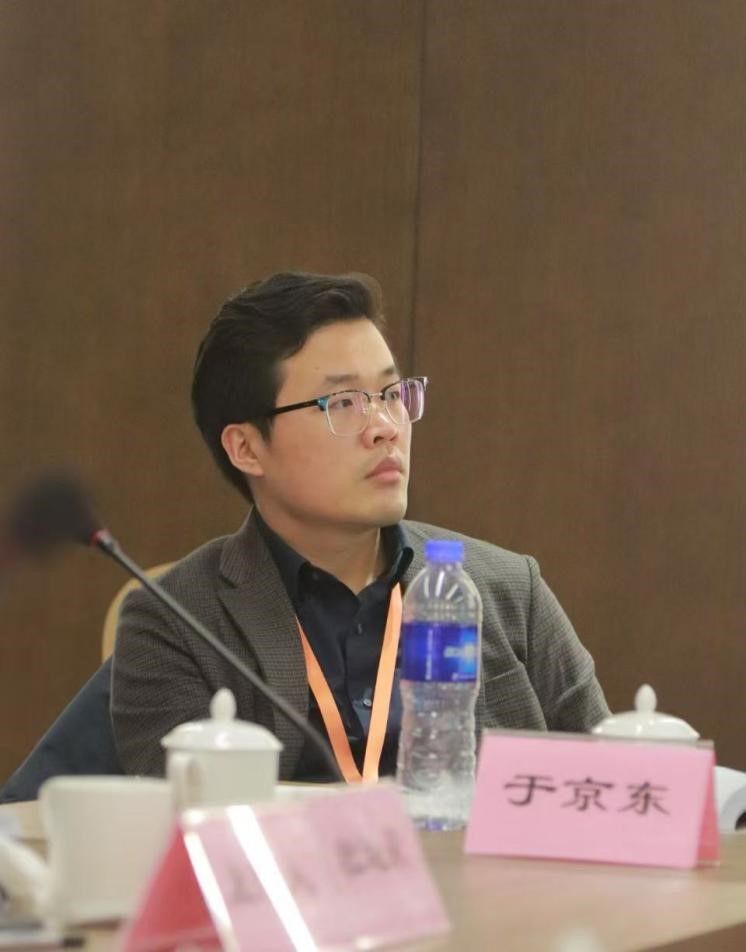
Yu Jingdong
Associate Professor, School of Government, Nanjing University
19th Resident Scholar, Institute for Advanced Studies in Humanities and Social Sciences, Nanjing University
Bonus Session: Academic Event at Librairie Avant-Garde
Librairie Avant-Garde Event
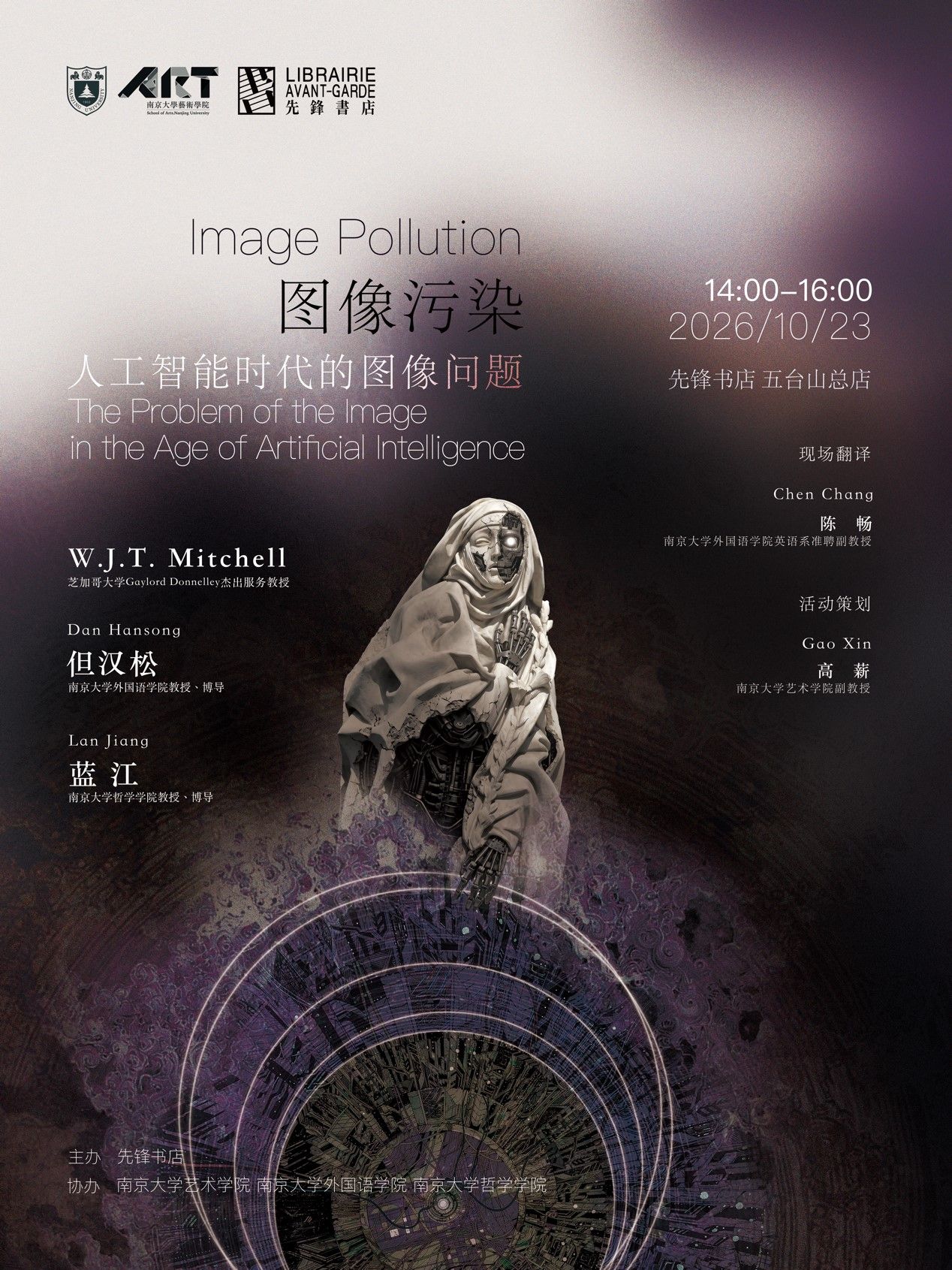
Image Pollution: The Problem of the Image in the Age of Artificial Intelligence
W. J. T. Mitchell × Lan Jiang × Dan Hansong
Event Curator
Gao Xin
On-site Interpreter
Chen Chang (School of Foreign Studies, Nanjing University)
For a long time, we have regarded images as objects of vision and cognition: they hang on walls, remain enclosed within screens, and silently await the arrival of consciousness. But this is only one half of the image. The other half of the image's existence has to be completed within us. Images deposit their spores in pigments, paper, and pixels—in what may be called tertiary retention or reservoirs of artificial memory—waiting for a conscious host. It is only at the moment of being seen that they awaken, become manifest, and take possession. Aristotle writes that "the soul never thinks without a phantasm" (οὐδέποτε νοεῖ ἄνευ φαντάσματος ἡ ψυχή, De Anima, III.7). In the Renaissance, Giordano Bruno accordingly asserted that the entire material of the mind is images. Husserl further revealed that consciousness is an uninterrupted flow of retention, admitting neither blanks nor pauses. This means that our consciousness is filled with images at every moment and consciousness itself is the medium of images. Every image that enters consciousness occupies a finite bandwidth of our attention; occupation is colonization. Bruno says bluntly: if you wish to manipulate an object, fill its mind with a particular image. The constitution of retention is the constitution of the self. We cannot become someone outside consciousness. Therefore, the images we possess determine who we become. On this parasitic behaviour, Hans Belting states: "we are not the masters of our images, but rather in a sense at their mercy; they colonize our bodies (our brains), so that even if it seems that we are in charge of generating them, and even though society attempts unceasingly to control them, it is in fact the images that are in control." Images are powerless and never need to exert brute force; they merely radiate temptation. The ropes that bind their prey are woven from the prey's own desires. The predator need only understand perfectly what its prey desires. When the effective rule of images operates not through violence but through desire, it cannot be resisted; one must either fast or become immune.
This academic event names this theory image pollution. When the supply chain of attention is industrially fed and the host's structure of retention is continually occupied, the toxicity of images depends not on their content but on their concentration and irreversibility. What we need to do, then, is not merely clean up a particular river, but regulate the total volume of emissions and the speed of purification. The resistance we advocate is not iconoclasm. Smashing images merely drives them into the darker recesses of the inner theater. Instead, we can explore an ascetic discipline of attention and practices of counter-imaging: replacing powerful images with more powerful affects, and confronting fed phantasms with self-made phantasms.
Date and Time: Friday, October 23, 2026, 2:00 – 4:00 p.m.
Location: Librairie Avant-Garde, Wutaishan Main Store
Organizer: Librairie Avant-Garde
Organizers
School of Arts, Nanjing University
International Affairs Office, Nanjing University
School of Foreign Studies, Nanjing University
Institute for Advanced Studies in Humanities and Social Sciences, Nanjing University
Project Director
Zhao Kuiying
(Dean and Professor, School of Arts, Nanjing University)
Project Planning and Academic Conveners
Zhou Jiwu
(Party Secretary and Professor, School of Arts, Nanjing University)
Wang Shixiao
(Tenure-track Assistant Professor, School of Arts, Nanjing University)
Hu Yiqing
(Deputy Director, Institute for Advanced Studies in Humanities and Social Sciences, Nanjing University; Professor, School of Journalism and Communication, Nanjing University)
Cao Danhong
(Deputy Dean and Professor, School of Foreign Studies, Nanjing University)
Norman MacLeod
(International Professor, School of Earth Sciences and Engineering, Nanjing University)
Gao Xin
(Associate Professor, School of Arts, Nanjing University)
Special Thanks
Qian Xiaohua
(Founder of Librairie Avant-Garde)
Administrative Assistants
Liu Yang, Yu Xia, Hu Zhiyue, Xu Shuyi, Zhou Yangdian, Sun Lin
Academic Assistants
Xu Aoqun, Hou Yu, Zhou Shang, Wang Jing, Zheng Yuxin, Yang Yilun, Wang Yuning, Qin Qi, Gu Wanqi, Xiao Yao
Visual Design
Hou Yu
Text by Prof. Gao Xin and Ph.D candidate Zheng Yuxin
(School of Arts)


