On July 17, 2026 (local time), the results of the 23rd ACM SIGEVO Human-Competitive Results Awards (HUMIES) were announced at the ACM Genetic and Evolutionary Computation Conference (GECCO 2026) held in San José, Costa Rica. The research achievement "Complex marine ecological response during the Eocene-Oligocene revealed by global foraminiferal record," led by Nanjing University, won the Silver Award. Professor Chao Qian from the School of Artificial Intelligence at Nanjing University presented the achievement and received the award on behalf of the team at the event.
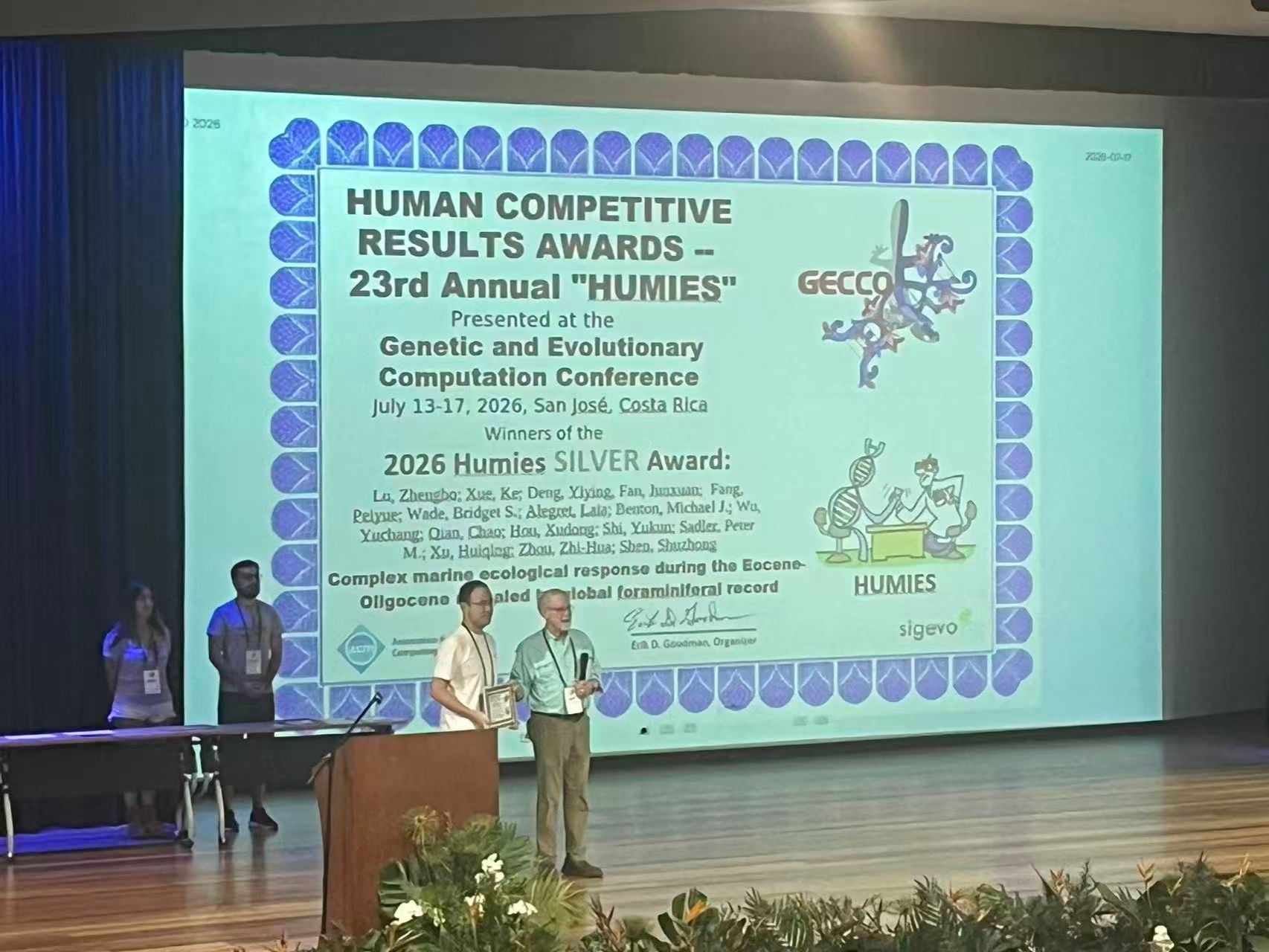
Professor Chao Qian (left) from the School of Artificial Intelligence at Nanjing University receiving the HUMIES Silver Award on behalf of the team at the ACM GECCO 2026 awards ceremony (Photo provided by the team)
This award-winning achievement was published on March 14, 2026, in Nature Communications. By deeply integrating a high-quality fossil database, quantitative stratigraphy methods, and artificial intelligence algorithms, the research team independently developed a new generation of artificial intelligence-inspired quantitative stratigraphy algorithms—Constrained Optimization with Evolutionary Algorithm (CONOP.EA). Using this algorithm, they accurately revealed for the first time the complex response patterns of different marine ecological groups during a period of drastic climate change approximately 33.9 million years ago. Previously, this achievement had received widespread attention and was covered by multiple mainstream media outlets, including the Guangming Daily, Xinhua Daily, and China News Service.
Award Overview
Competition for this year's HUMIES awards was fierce, with candidate projects from renowned universities and top research institutions such as Google DeepMind, Sakana AI, and University College London. Ultimately, the Gold Award was captured by the Google DeepMind team, while the CONOP.EA achievement led by Nanjing University won the Silver Award. This marks the first time since the award's inception in 2004 that a Chinese institution, acting as the lead organization, has won a Silver Award, signifying that China has entered the international forefront in AI method innovation and AI for Science applications.
Project Introduction
The Eocene-Oligocene Transition (EOT; about 33.9 million years ago) is a critical node in Earth's shift from a "greenhouse" to an "icehouse" state. At that time, continental-scale permanent ice sheets began to form on Antarctica, and the global climate and environment underwent drastic reorganization. How marine life responded to this severe environmental change is one of the core scientific questions in understanding deep-time climate-environment-life co-evolution.
To solve this problem, the research team utilized their self-developed big data platform for stratigraphic paleontology—OneStratigraphy—to systematically collect and integrate foraminifera fossil data from 161 stratigraphic sections and drillholes globally. After strict data cleaning and screening, they ultimately obtained about 40,000 fossil occurrence records of 1,269 foraminifera species. Building upon this foundation, they innovatively developed a new-generation AI-inspired quantitative stratigraphy algorithm: Constrained Optimization with Evolutionary Algorithm (CONOP.EA).
The core idea of this algorithm is to simulate each possible global stratigraphic correlation scheme as a piece of "DNA," and then allow these "DNAs" to undergo mutation, recombination, and natural selection, much like living organisms. Through "survival of the fittest" continuous evolution, the most reasonable and consistent stratigraphic correlation result is ultimately selected. It is worth mentioning that, based on the prior accumulation of the School of Artificial Intelligence at Nanjing University in evolutionary learning theory, the team made innovations in multiple components of the evolutionary algorithm. These innovations include introducing domain knowledge-based solution initialization, learning-based adaptive mutation, and diversity-based recombination strategies. This improved the computational efficiency of CONOP.EA by approximately 23 times compared to the previous-generation CONOP.SAGA algorithm, enabling efficient processing of large-scale fossil record data and the plotting of a high-resolution global foraminifera diversity curve spanning 28 million years with a temporal resolution of 29,000 years.
In-depth analysis based on this curve revealed that different ecological types of foraminifera exhibited distinctly different responses to the EOT environmental changes: planktonic and larger benthic foraminifera experienced significant extinction during the ice sheet formation period, while small benthic foraminifera underwent radiation earlier, before entering a prolonged decline. The marine ecological response during the EOT is characterized by complexity and ecological differentiation, and cannot be simply attributed to a single driving mechanism.
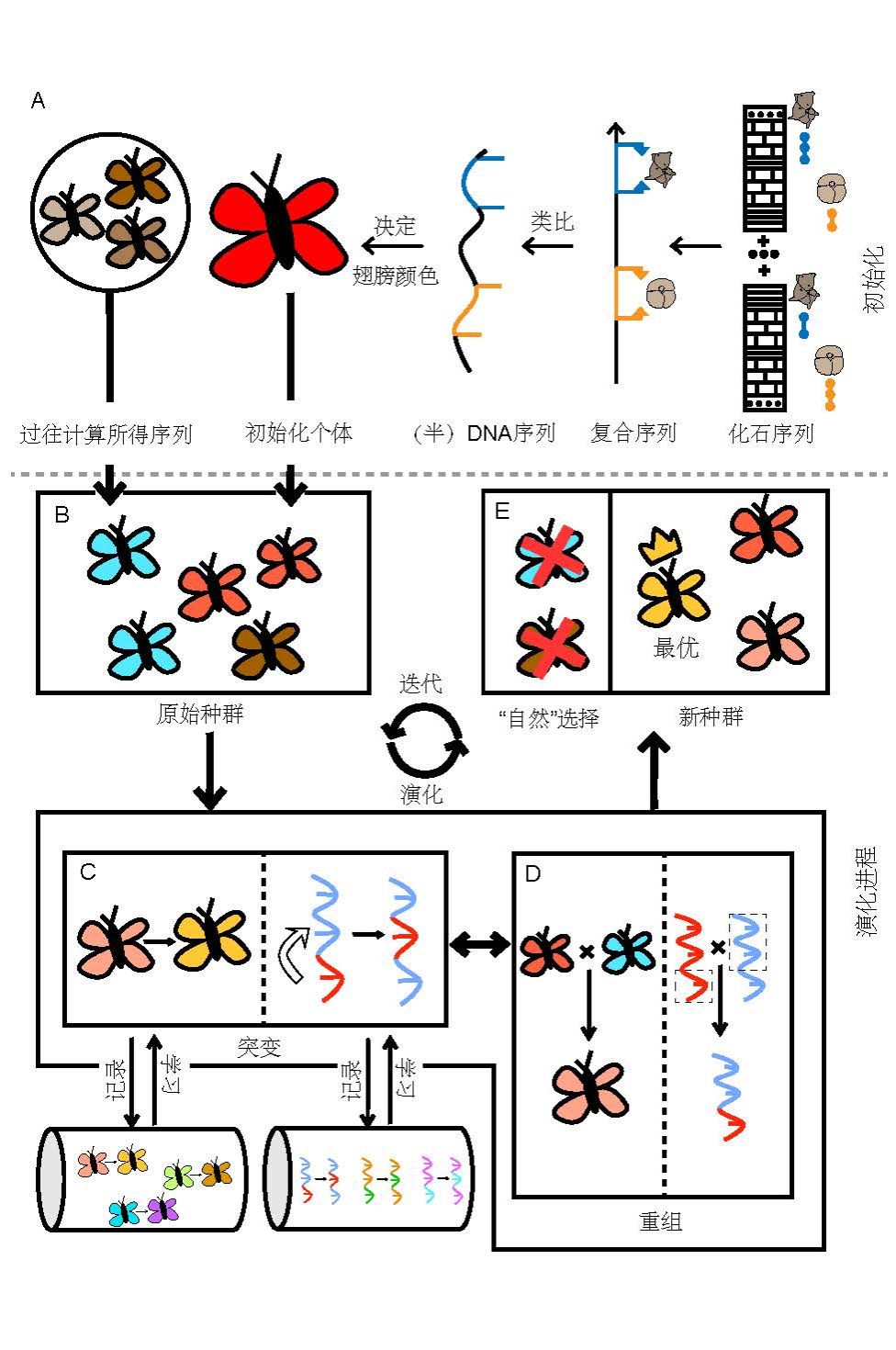
Figure 2. Schematic diagram of the CONOP.EA algorithm workflow. The algorithm repeatedly iterates through initialization, mutation, recombination, and natural selection to ultimately obtain the optimal stratigraphic correlation result (Image source: Paper)
Team Profile
The first authors of the paper are Zhengbo Lu, Ke Xue, and Yiying Deng, and the co-corresponding authors are Junxuan Fan, Chao Qian, and Yukun Shi. Among them, Professor Junxuan Fan, Professor Yukun Shi, and Ph.D. student Zhengbo Lu are from the School of Earth Sciences and Engineering at Nanjing University; Professor Chao Qian and Dr. Ke Xue are from the School of Artificial Intelligence at Nanjing University; Yiying Deng is from the School of Resources and Environmental Engineering at Hefei University of Technology. Since March 2021, the interdisciplinary team, led by Professors Fan Junxuan, Shi Yukun, and Qian Chao, has focused on the research theme of "AI Empowering Deep-Time Evolution of Life". Through a regular joint meeting mechanism, they have deeply collaborated on data curation, refinement of scientific questions, algorithm design, result verification, and scientific interpretation. This award-winning achievement is the first landmark output of this innovative interdisciplinary cooperation model.
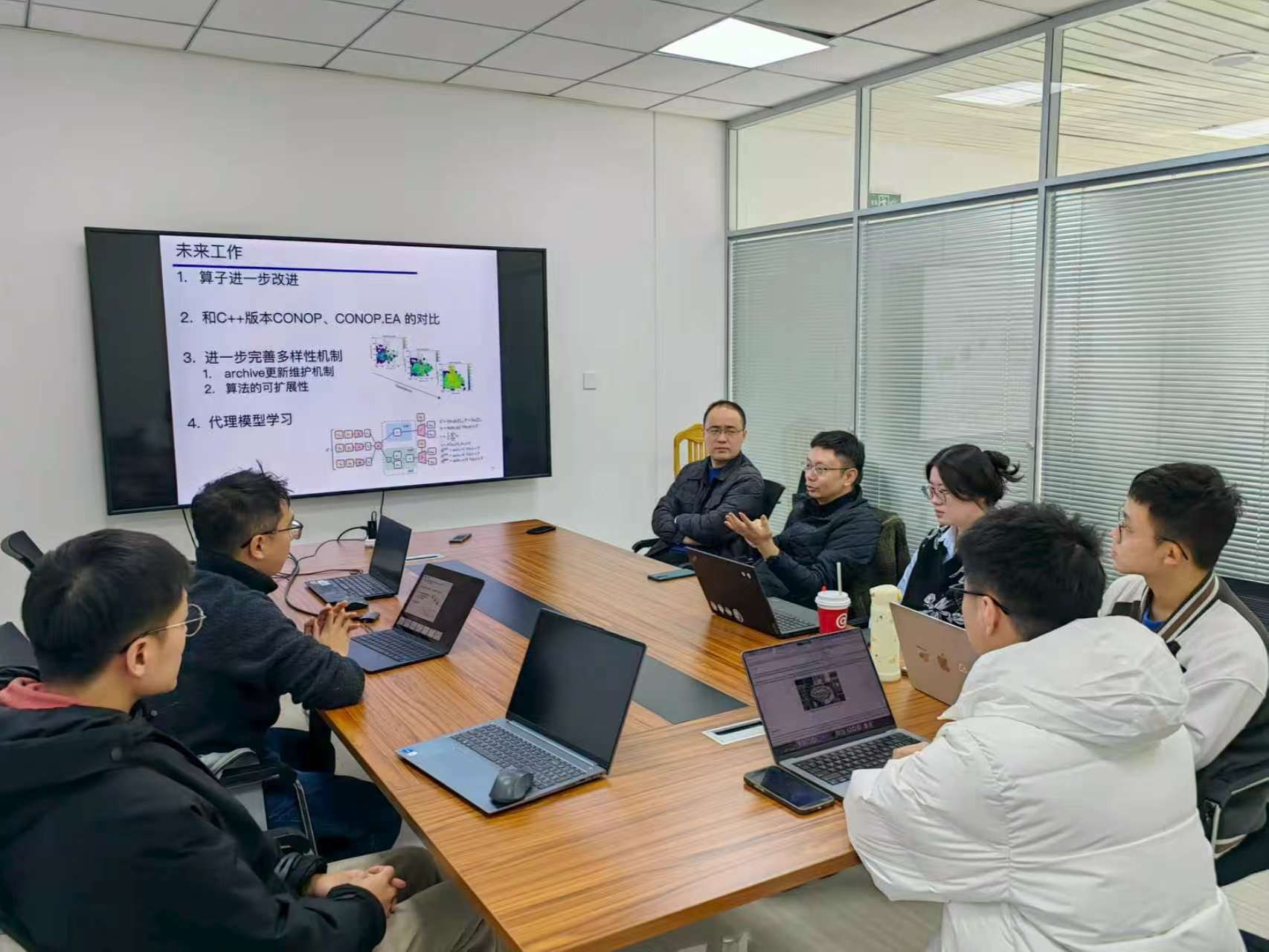
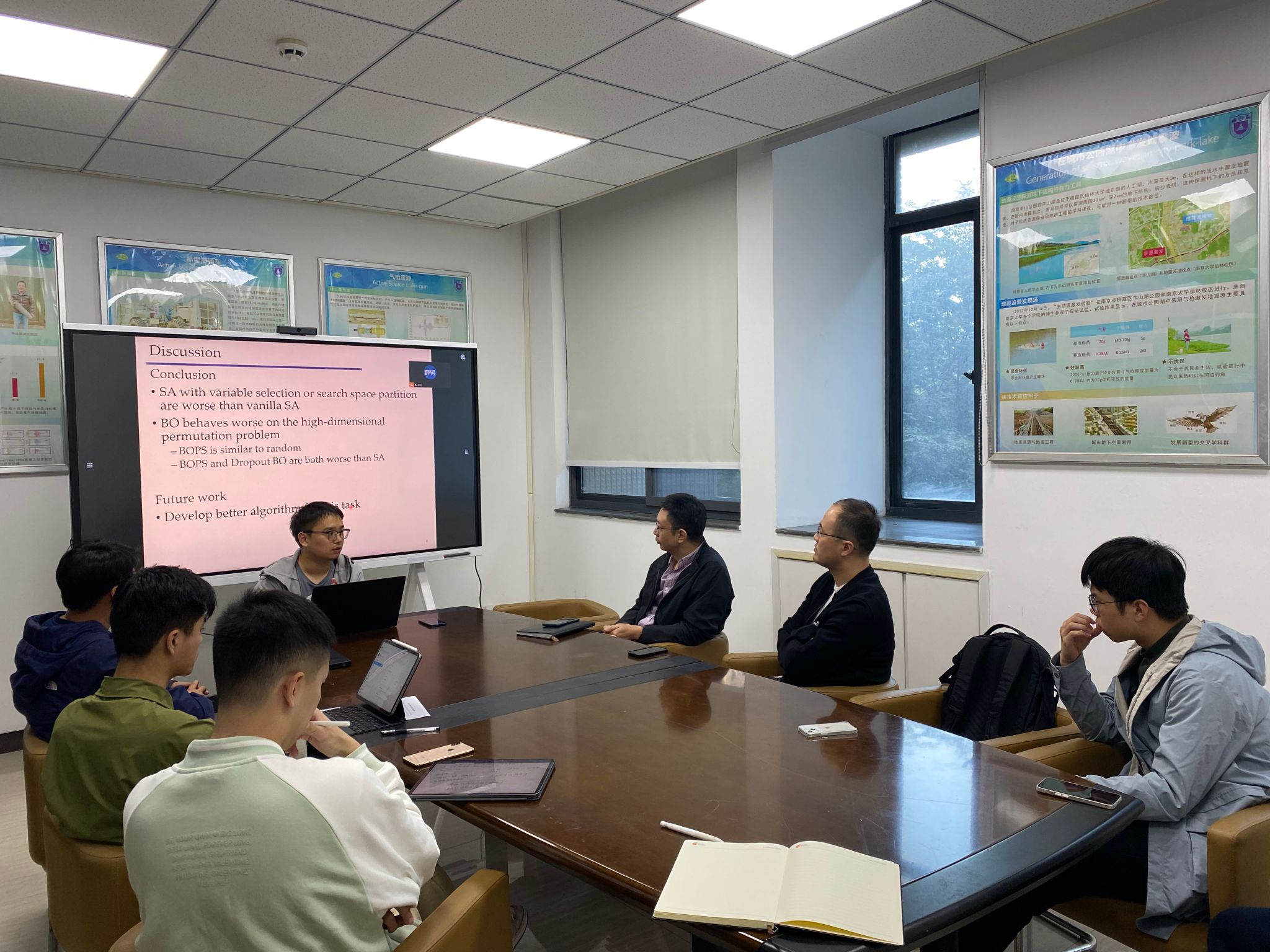
Since 2021, the interdisciplinary team has continuously engaged in communication and collaboration centered around CONOP.EA algorithm design, data analysis, baseline comparison, and subsequent improvements (Photo provided by the team)
Award Background
HUMIES, fully known as the Human-Competitive Results Awards, was established in 2004, and 2026 marks its 23rd edition. The competition is held during GECCO, the flagship conference hosted by the ACM Special Interest Group on Genetic and Evolutionary Computation (ACM SIGEVO). The award does not rank based on a single performance metric, but rather emphasizes "human competitiveness": whether the submitted achievement reaches or surpasses existing human levels and solves recognized challenges in the field. The award pays special attention to whether AI algorithms can step out of laboratory benchmarks and create verifiable value in scientific research and real-world tasks. As the most representative award for human-competitive achievements in the field of evolutionary computation, previous HUMIES winners include researchers from world-class universities such as Stanford University, the Massachusetts Institute of Technology, Cornell University, and University College London, as well as top research institutions and companies like NASA, Google, and Meta.
Nanjing University's leading role in winning this award reflects this evaluation orientation: the algorithm not only significantly improved the computational efficiency of global fossil stratigraphic correlation but also provided new high-resolution evidence for understanding major biological events in deep time. This research further highlights the enormous potential of deeply integrating high-quality fossil databases, quantitative stratigraphy methods, and artificial intelligence algorithms, offering a new methodological pathway for global research on the co-evolution of deep-time life and the environment.
This achievement is a major output of Nanjing University in the strategic direction of "AI for Science" and provides a landmark example for the deep interdisciplinary integration and development of earth sciences and artificial intelligence.
Related Links
· HUMIES Past Winners List (Official)
· GECCO 2026 HUMIES Call for Entries and Schedule (Official)
· Previous Report by the School of Earth Sciences and Engineering, Nanjing University
· Previous Report on Nanjing University's Homepage
· Previous Report by Guangming Daily
· Previous Report by China News Service


